CASE STUDY — 2025
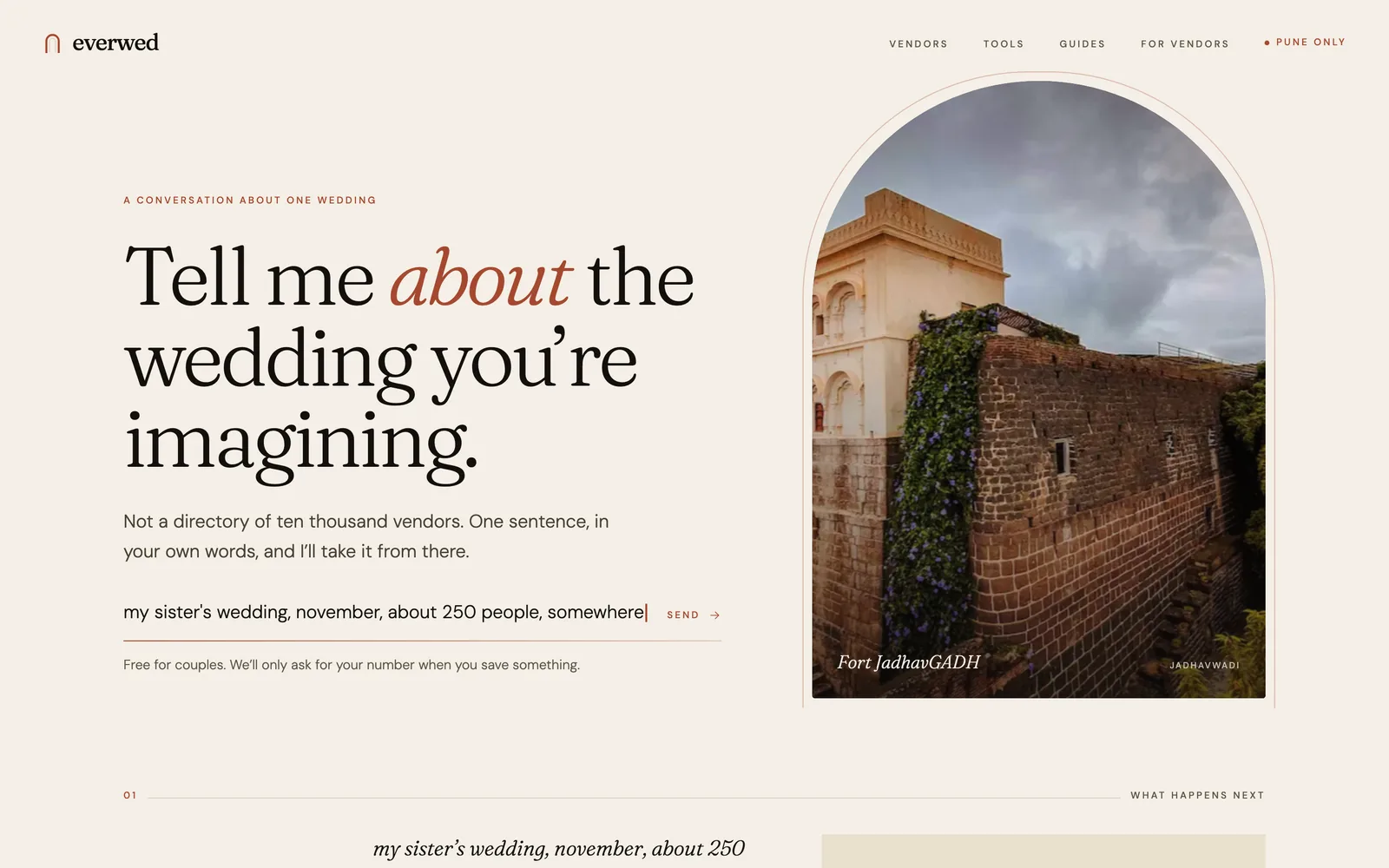
We wrote one sentence before we built anything.“Tell me about the wedding you’re imagining.”
Every wedding deserves to feel effortless.YEAR
2025
delivery year
SCOPE
Built from zero
product to deployment
CLIENT
Everwed
everwed.in
FOR
Pune couples
starting city-first
THE CLIENT
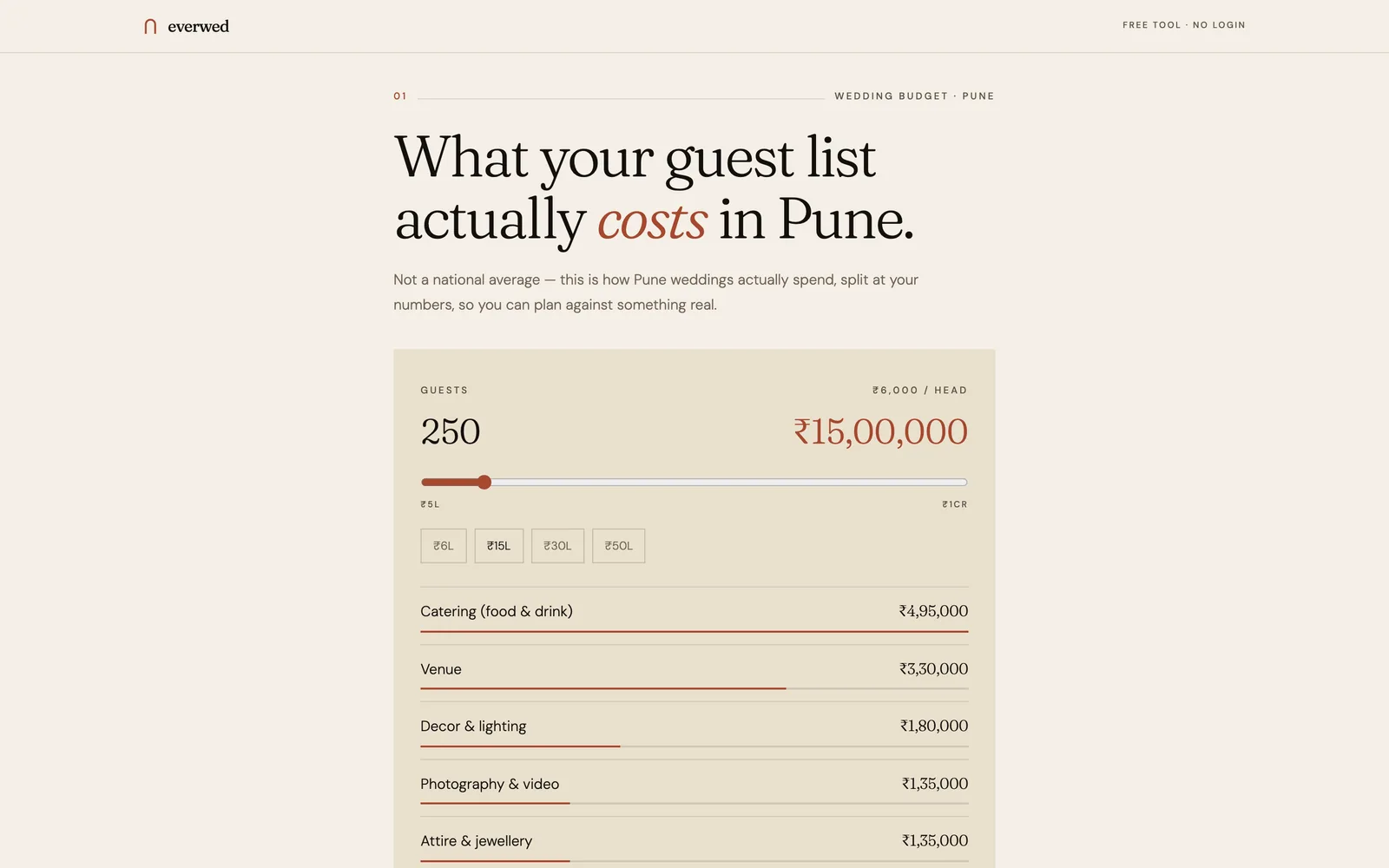
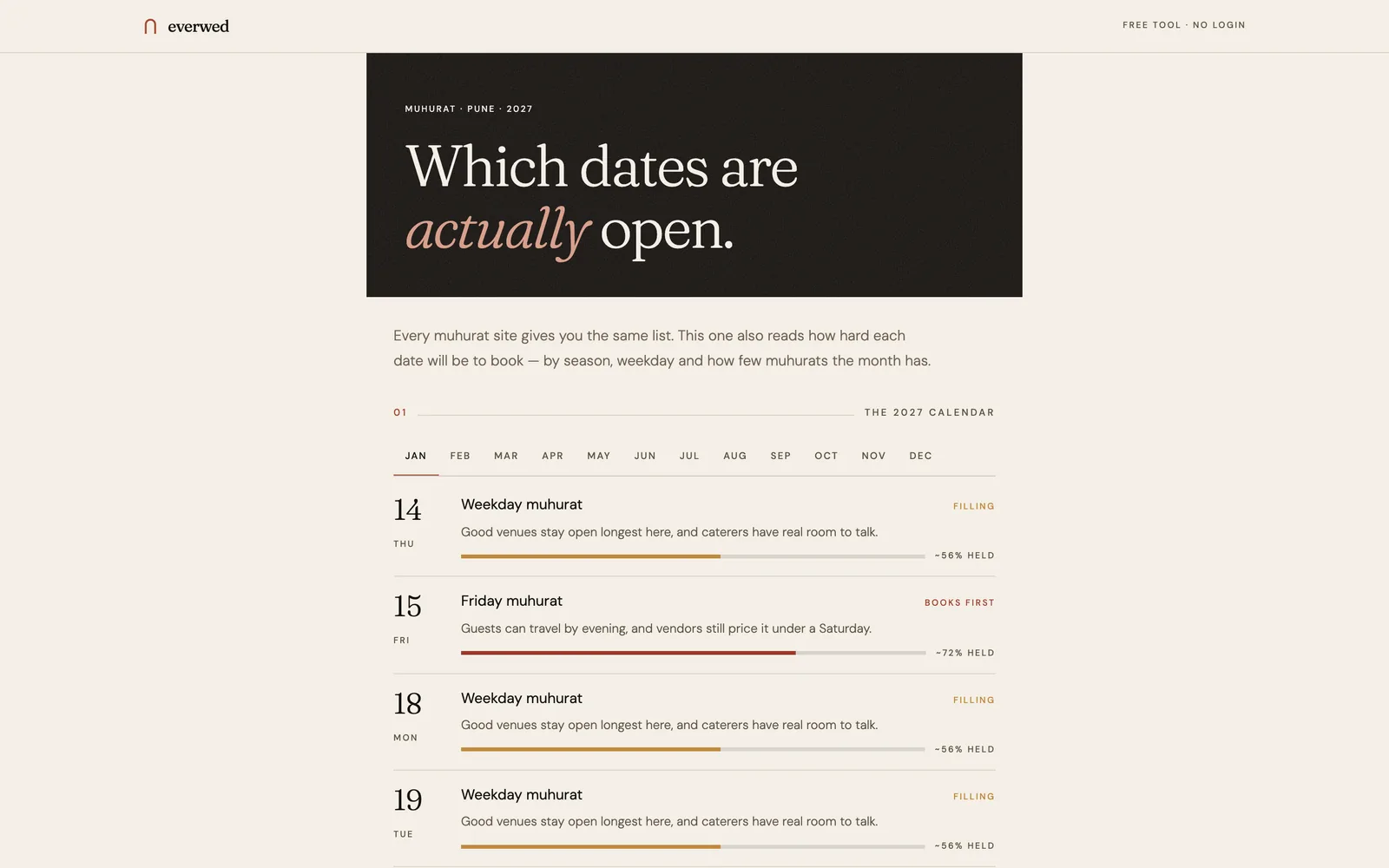
Everwed is an AI-powered wedding planning tool for couples in Pune — built from zero. Product strategy, brand, design system, database architecture, and the AI interaction itself. Our scope was end-to-end: the strategy that explained what Everwed should be and what it isn’t, and the build that made it real.
The market it sits in is crowded with the wrong answers. WedMeGood gives you 10,000 vendors and a “Get 5 quotes” button. ShaadiSaga gives you gold and maroon. Wedd.ai puts AI in its name and treats that as a personality. Everwed was a bet on a different register entirely: a calm, competent voice that behaves like a close friend who has done this before — never performing warmth, never pushing, always knowing what to say next.
THE CHALLENGE
Every competitor’s mistake was available to copy.
The Indian wedding-tech market has a documented aesthetic: gold palettes, Playfair Display, Sanskrit-adjacent copy, AI features labelled as “AI features.” Everwed needed to refuse all of it — not as a design preference, but as a strategic claim. The couples we were building for are planning one of the most expensive days of their lives. They don’t need a brand that performs excitement at them. They need a brand that feels like it has done this before.
The AI’s voice was the product
Every AI tool has system prompts and a UI. The hard thing is the first sentence. Everwed’s AI opens with: “Tell me about the wedding you’re imagining.” That sentence was written before a line of code. It does three things simultaneously: it’s open-ended (no form fields), it’s conversational (not a prompt), and it signals immediately that this is a conversation about one specific wedding — not a directory search. Getting that sentence wrong would have made every screen that followed feel hollow. We wrote it first.
The AI needed a personality, not a name
Most AI products give the AI a name (Siri, Alexa, Lia, Lila). We argued against it for Everwed — and the argument held. Naming the AI invites questions about gender, backstory, and personality that pull focus away from the couple’s wedding and onto the product. More importantly, a named AI gets tested (“what’s your favourite colour?”), joked with, and anthropomorphised in ways that erode the experience. Everwed’s AI is unnamed — it’s Everwed, or it’s nothing. It says “I,” speaks directly, and never breaks the fourth wall to remind the user it is an AI. The personality lives in what it says, not what it’s called.
Trust had to come before data collection
Indian wedding platforms ask for your number within the first two screens. Everwed doesn’t. Anonymous conversations are supported from the start — the AI can recommend vendors, a couple can view listings and request quotes, and the platform doesn’t ask for a phone number until the couple is ready to save their plan. This was an architectural decision with significant database implications (anonymous conversations, cookie-based session management, late account creation via OTP). It was also the right call: a brand that says “your details stay yours until you choose to share them” and then immediately asks for your number is lying.
Pune first — or it would be everything and nothing
The product works in Pune because we constrained it to Pune. The vendor database is Pune vendors. The AI’s knowledge of neighbourhoods (Bavdhan, Kothrud, Wakad, Koregaon Park) is precise because we stayed inside one city. “Launch in India” is how you build a directory. “Dominate Pune” is how you build a product. Bangalore comes in year two, only if we’ve nailed Pune — and that sentence is in the brand document.
WHAT WE BUILT — AND WHY IT’S BUILT THIS WAY
The decisions that defined the product.
WHAT EVERWED DOES
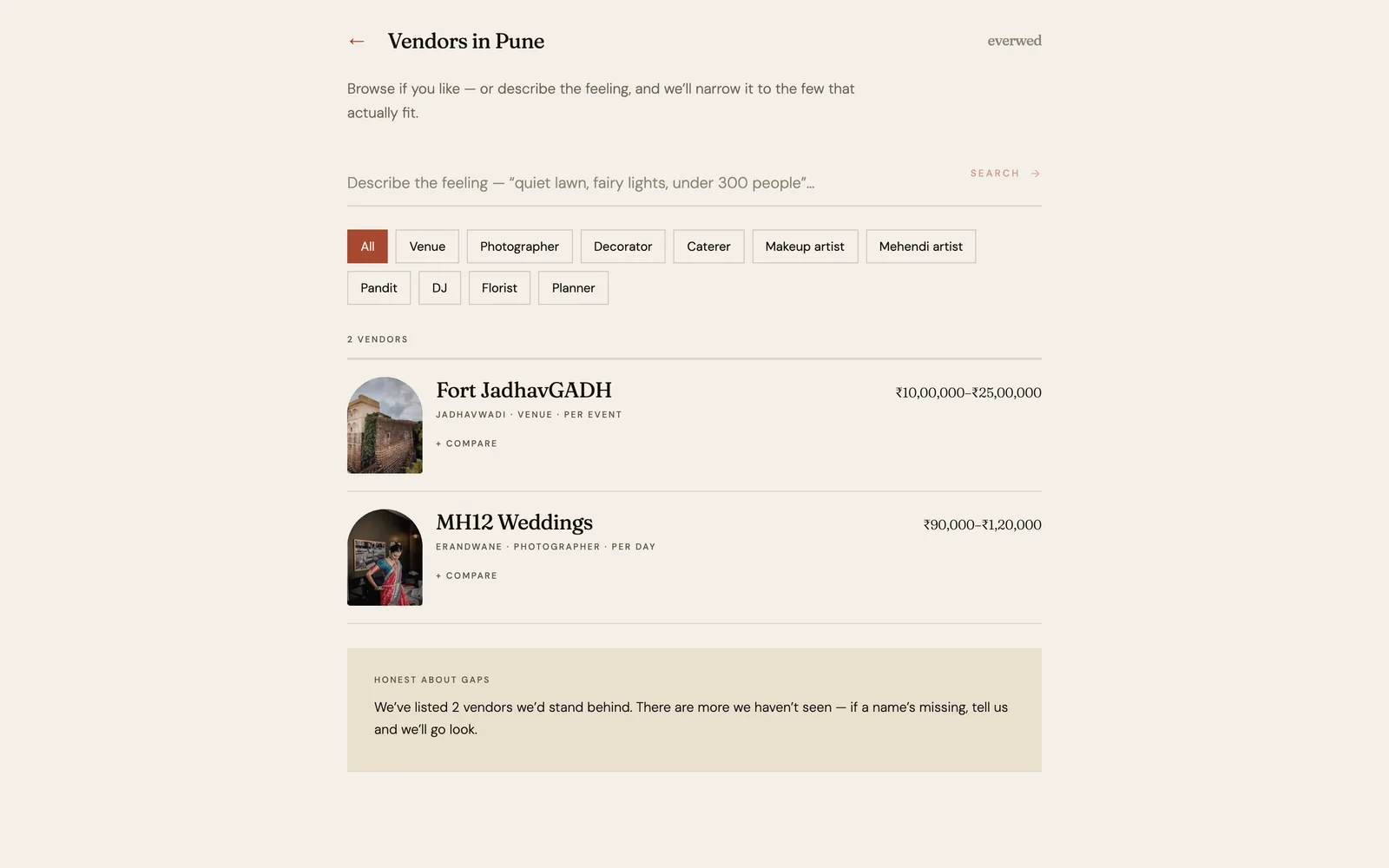
AI co-pilot that recommends Pune vendors from a natural-language conversation
Semantic search with pgvector — the AI retrieves the 8 most relevant vendors, then selects the 3 best for this specific wedding
Vendor detail pages with AI-personalized “Why this fits” — generated from the couple’s most recent conversation context
Quote request flow → WhatsApp lead delivery to vendors via AiSensy
Phone OTP account creation — late in the flow, after the couple has already seen value
Saved vendors, accessible without an account via localStorage until OTP
One question at a time
The AI never stacks two questions. This is a voice principle and a system prompt rule. “Whose wedding and when?” reads like a form. “Whose wedding?” followed by “And when are you thinking?” is a conversation. The difference is not subtle — it’s the entire register.
No exclamation marks
This holds across the product and the brand. Default to periods. The period is composure. A wedding platform that says “Exciting! Let’s start planning your dream wedding!” is performing enthusiasm at people who are stressed. Everwed speaks like someone who has seen this before and knows it will be fine.
The AI’s first message is the brand
“Tell me about the wedding you’re imagining.” is not a tagline. It is the first thing the AI says, every time. Brand voice is not what appears in a style guide — it’s what appears in the product at the moment that matters most.
THE OUTCOME
Three vendors. Not a search results page.
The everwed.in MVP shipped with a seeded vendor database (photographers, venues, decorators, makeup artists, caterers — targeted at 50 well-described vendors before consumer marketing), a working AI discovery engine, quote request to WhatsApp delivery, and the account creation flow.
The AI performs. Given “I want a Marathi wedding in November for 200 people in Bavdhan,” it returns three specific vendor recommendations — not a list of photographers, not a search results page, but three vendors with a paragraph on why each one fits this specific wedding. That paragraph references Bavdhan. It references November. It references a 200-guest Marathi function, not a generic “event.”
That level of specificity is not incidental. It is the product.
HONEST REFLECTION
“The AI is only as good as the vendors it can recommend from. We shipped the discovery engine before the vendor database was fully seeded — which meant the first test couples saw a thinner set of results than the product deserved. The right order is: seed 50 vendors with real depth (3+ photos, a thoughtful description, verified pricing) before consumer marketing begins. Volume doesn’t compensate for thin listings. Thirty well-described vendors beat 150 empty profiles.”
Planning a wedding product? We’ll think about it with you.
The vendor strategy, the voice, and the AI.
We build the whole thing.